Part I Introduction to Pickleball
Section 1 The Game
Pickleball is a paddle sport that combines elements of badminton, table tennis, and tennis. It is played using a special perforated ball on a 20-foot by 44-foot court with a tennis type net. The court is divided into right and left service courts and a non-volley zone on each end of the net (Figure 3-1).
Pickleball can be played as singles or doubles.
In standard pickleball, the ball is served diagonally across the net to the opposite service court on the opponent’s end, using an approved motion.
The ball is then hit back and forth across the net until a player fails to return the ball in accordance with the rules.
Standard pickleball uses a scoring method where points are scored only when the serving team wins the rally. The server alternates service courts and continues to serve until they lose a rally (commit a fault). Typically, the first player or team scoring 11 points and leading by at least a 2-point margin wins the game.
Rally scoring has been provisionally approved as an option (Rule 14.A), wherein a point is scored by the team that wins each rally. Mini-singles (Rule 14.B) is a half-court variation of standard singles.
Unique Features
Two-Bounce Rule. After the serve, the receiver must allow the ball to bounce before making their first return, and then the serving team must allow the ball to bounce before making their first return.
Non-Volley Zone. The non-volley zone is the area of the court that extends 7 feet from the net on each end of the court, within which a player is not allowed to hit the ball out of the air before it bounces.
Wheelchair and Adaptive Play. Players using wheelchairs and players having certain disabilities may allow the ball to bounce twice before returning the ball. The first bounce must be in the court, but the second bounce can be anywhere on the playing surface.
Underlying Principles
Pickleball is a game that requires cooperation and courtesy. A sense of fair play by giving the opponent the benefit of any doubt is essential in maintaining the game’s underlying principles of fun and competition.
All points played are treated the same regardless of their importance: the first point of the match is as important as match point.
Either partner in doubles can make calls, especially line calls.
Calls are made promptly to preserve fair play and prevent players from making delayed calls for their own advantage.
Players strive to cooperate when confronted with a situation not covered by the Rulebook. Resolutions can be made by asking for a referee to resolve a dispute. allowing the rally to stand, or in extreme cases, a replay of the rally.
Where possible, rules accommodate players with various adaptive needs.
Players avoid wearing clothing that closely matches the ball color.
Players should not question or comment on an opponent’s call except through an appeal to a referee.
Section 2 Definitions
Ball In Play. The timeframe during which a rally is played, from when the serve is hit until the ball becomes dead.
Carry. Hitting the ball in such a way that it does not bounce away from the paddle but is carried along on the face of the paddle.
Coaching. Communication of information (including verbal, nonverbal, and electronic) from someone other than a player’s partner, that players may act upon to gain an advantage or help them avoid a rules violation.
Court. The area inside the outer dimensions of the baselines and sidelines.
Dead Ball. A ball that is no longer in play.
Distraction. Physical actions by a player that are not common to the game and interfere with the opponent’s ability or concentration to hit the ball. Examples include, but are not limited to, making loud noises, stomping feet, and waving the paddle in an erratic manner.
Double Bounce. When the ball bounces twice on one end of the net before it is returned.
Double Hit. Hitting the ball twice before it is returned.
Drop Serve. A serve made by dropping the ball and hitting the ball with the paddle after the ball bounces on the playing surface.
Ejection. Removal of a player from tournament competition for a flagrant or injurious behavioral violation.
Expulsion. Banishment of a player from the tournament venue for a flagrant or injurious behavioral violation.
Fault. A rules violation that results in a dead ball and the loss of a rally.
First Server (Doubles). The player who begins the team’s service rotation from the right serving area after a side out.
Forfeit. The awarding of a game or a match to the opponent due to a violation of the rules.
Hinder. Any transient element or occurrence not caused by a player that adversely impacts play. Examples include, but are not limited to, stray balls, flying insects, foreign material, players, or officials on another court that impacted a player’s ability to make a play on the ball. (Permanent objects are not hinders.)
Imaginary Extension. The continuation of a line beyond its actual, physical endpoint, as if the line were projected further even though it is not drawn or present.
Line Call. An audible or visual signal that a ball in play has not landed in the required court area.
Live Ball. The timeframe from the start of the score call until the ball becomes dead.
Momentum. A property of a body in motion that causes a player to continue in motion after contacting the ball. The act of volleying produces momentum that ends when the player regains balance and control of their motion or stops moving toward the non-volley zone.
Non-Volley Zone. The 7-foot by 20-foot area of the court on each end of the net where players are not allowed to volley the ball. (See Rule 3.A.4.c for specifications.)
Officiating Team. Personnel under the leadership of the Tournament Head Referee on or off the playing surface, including Lead and Second Referees, Tracking Referee, Video Replay Referee, and Line Judges.
Paddle Grip Adjustments. Non-mechanical devices that change the size of the grip or stabilize a player’s hand on the grip.
Paddle Head. The paddle, excluding the handle.
Permanent Object. Any object on, above, or near the court that can interfere with play. Examples include, but are not limited to ceilings, walls, fencing, lighting fixtures, net posts (including connected wheels, arms, and legs). Net cable or rope on top of the net post, and other net support construction. Stands and seats for spectators, the referee, line judges, spectators when in their recognized positions, and all other objects around and above the court.
Plane of the Net. The vertical plane in line with the net extending above, below, and to both sides of the net.
Playing Surface. The court and the area surrounding the court designated for playing.
Profanity. Words, phrases, or gestures commonly considered to be vulgar or inappropriate in public or around children. Typically included are words used as expletives or verbal intensifiers.
Rally. Continuous play that occurs after the serve is hit and before the ball becomes dead.
Receiver. The player who returns the serve.
Replay. The restart of a rally without the awarding of a point or changing of the server.
Retirement. A singles player or doubles team’s decision to discontinue playing in a match in progress.
Second Serve (Doubles). A term used to describe the serving condition after the first server loses their serve.
Second Server (Doubles). The first server’s partner. The second server serves after the first server loses serve.
Serve. The initial strike of the ball with the paddle to start a rally.
Server. The player who initiates a rally by serving the ball.
Service Court. The area of the court on either side of the centerline, excluding the non-volley zone. (See Rule 3.A.4.f for specifications.)
Serving Area. The area behind the baseline on each end of the court. (See Rule
3.A.4.g for specifications.)
Side Out. The awarding of the serve to the opposing team after a singles player or doubles team loses its serve.
Starting Server (Doubles). For each doubles team, the player designated to serve first at the start of a game.
Technical Foul. A one-point penalty assessed for extreme unsportsmanlike actions or behaviors.
Technical Warning. A punitive warning assessed for minor unsportsmanlike actions or behaviors.
Verbal Warning. A non-punitive caution for minor unsportsmanlike behavior, usually given in advance of assessing a technical warning or technical foul for such behavior.
Volley. A strike of the ball before the ball bounces.
Volley Serve. A serve made by hitting the released ball with the paddle before the ball bounces on the playing surface.
Volleying, Act of. The act of volleying begins when the ball is hit out of the air before bouncing (i.e., volleyed) and ends when the player’s movement from the follow-through action (i.e., momentum) stops.
Withdrawal. A singles player’s or doubles team’s decision to be removed from all upcoming play in a specified bracket.
Section 3 Court and Equipment
3.A Court Specifications. The dimensions and measurements for the standard pickleball court are shown in Figure 3-1.
Figure 3-1: Court Specifications
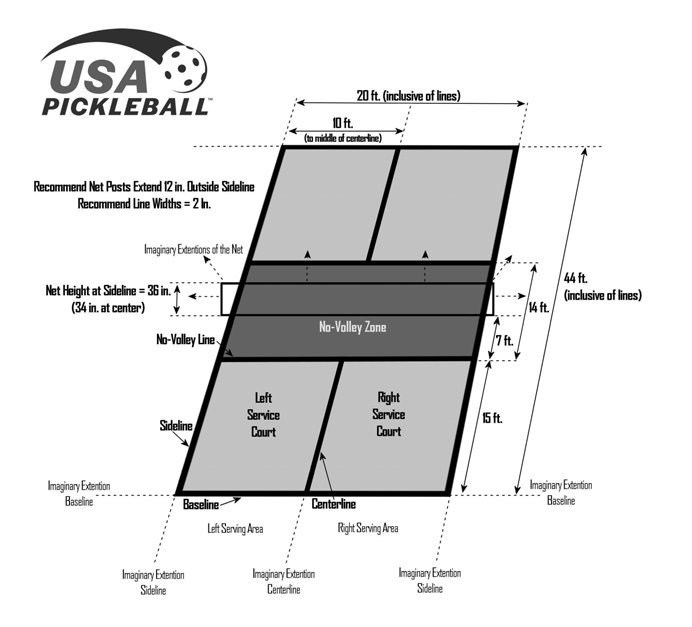
3.A.1 Court Dimensions. The court must be a rectangle measuring 20 feet (6.10 m) wide and 44 feet (13.41 m) long for both singles and doubles matches. (See Figure 3-1.)
3.A.2 Court Measurements. Court measurements must be made to the outside edge of the perimeter and non-volley zone lines.
3.A.3 Playing Surface. The minimum playing surface area is 30 feet (9.14 m) wide and 60 feet (18.29 m) long. Other recommendations for playing surface dimensions are:
Purpose Width – feet Length – feet (meters) (meters) New Construction 34 ft (10.36 m) 64 ft (19.5 m)
Tournament Play 34 ft (10.36 m) 64 ft (19.5 m) Stadium Court 50 ft (15.24 m) 80 ft (24.38 m)
3.A.4 Lines and Areas. The lines and areas of the standard pickleball court are described in Rules 3.A.4.a through 3.A.4.g. (See Figure 3- 1.)
3.A.4.a Baselines. The lines parallel to the net at each end of the court.
3.A.4.b Sidelines. The two lines bounding the court that are perpendicular to the net and baselines.
3.A.4.c Non-Volley Zone. The 7-foot by 20-foot (2.13.m by 6.08 m) area of the court adjacent to each end of the net. The non-volley zone lines run parallel to the net, 7 feet (2.13 m) from the net on each end between the two sidelines. All lines that bound the non-volley zone are part of the zone. The non-volley zone is two-dimensional and does not extend above the playing surface.
3.A.4.d Centerline. The line down the center of the court on each end of the court extending from the non-volley zone line to the baseline. The centerline separates the right and left service courts.
3.A.4.e Line Size and Color. All lines should be 2 inches (5.08 cm) wide and the same color, clearly contrasting with the color of the playing surface and court.
3.A.4.f Service Courts. The areas on each end of the court between the non-volley zone and the baseline on either side of the centerline. The right and left service courts are bounded by and include their adjacent baseline, sideline, and the centerline.
3.A.4.g Serving Areas. The areas behind the baseline on each end of the court. The right and left serving areas are bounded by and include the imaginary extensions of their adjacent sideline and the centerline.
3.B Net Specifications. The requirements for the net and related elements are set forth in Rules 3.B.1 through 3.B.7.
3.B.1 Material. The net may be made of any mesh fabric material that will not allow a ball to pass through it.
3.B.2 Posts. Net posts should be 22 feet +/- 1.0 inches (6.71 m) from the inside of one post to the inside of the other post. The maximum diameter of the net posts should be 3 inches (7.62 cm).
3.B.3 Size. The net length should be at least 21 feet 9 inches (6.63 m), extending from one post to the other. The net measurement from the bottom edge of the net to the top should be at least 30 inches (76.2 cm).
3.B.4 Edging. The top of the net should be edged with a 2-inch (5.08 cm) white tape binding over a cord or cable running through the binding. This binding must rest upon the cord or cable.
3.B.5 Center Strap. A strap may be placed at the center of the net (centered 10 feet from the outside edge of the sidelines) to enable adjustment to the required center net height.
3.B.6 Sideline Net Height. The top of the net must be 36 inches +/- 0.25 inch (91.44 cm +/- 0.635 cm) above the playing surface where the net crosses the outer edge of the sidelines. (See Figure 3-1.)
3.B.7 Center Net Height. The top of the net must be 34 inches +/- 0.25 inch (86.36 cm +/- 0.635 cm) above the playing surface at the center point of the court. If there is a center strap, the center net height measurement includes the center strap. (See Figure 3-1.)
3.C Ball Specifications. The requirements for the ball are set forth in Rules 3.C.1 through 3.C.5. The complete list of approved balls is posted on the USA Pickleball website.
3.C.1 Usage. All approved balls are acceptable for indoor or outdoor play. (See Figure 3-2.)
3.C.2 Design. The design of the ball must be approved by USA Pickleball as detailed in the Equipment Standards Manual. USA Pickleball
Equipment Standards Manual
3.C.3 Color. The ball must be one uniform color, except for identification markings. Colors may vary.
3.C.4 Brand Identification. The ball must have a manufacturer or supplier name or logo printed or embossed on the surface.
3.C.5 Construction. The ball must be made of durable material molded with a smooth surface and free of texturing. The ball may have a
slight ridge at the seam, as long as it does not significantly impact the ball’s flight characteristics. (See Figure 3-2.)
The ball with larger holes is customarily used for indoor play (pictured on the left). The ball with smaller holes is customarily used for outdoor play (pictured on the right).
Figure 3-2: Approved Balls – Examples


3.D Paddle Specifications. The requirements for the paddle are set forth in Rules 3.D.1 through 3.D.7. The complete list of approved paddles is posted on the USA Pickleball Approved Paddle List.
3.D.1 Brand and Model Identification. The manufacturer must have a clearly marked brand and model name or model number on the paddle and must also include the ‘USA Pickleball Approved’ seal or text treatment. Paddles that were manufactured prior to the seal or text treatment requirement must still be on the USA Pickleball approved paddle list for sanctioned play.
3.D.2 Dimensions. The combined length and width of the paddle, including any edge guard and butt cap, must not exceed 24 inches (60.96 cm). The paddle length must not exceed 17 inches (43.18 cm). There is no restriction on paddle thickness.
3.D.3 Weight. There is no restriction on paddle weight.
3.D.4 Material. The paddle must be made of material deemed safe and not prohibited by these rules. Paddles must be made of rigid, non-compressible material meeting the criteria specified in the USA Pickleball Equipment Standards Manual.
3.D.5 Prohibited Surface Features. The paddle’s hitting surface must not contain:
3.D.5.a Holes, cracks, delamination, or indentations that break the paddle skin or surface.
3.D.5.b Rough texturing.
3.D.5.c Sandpaper characteristics.
3.D.5.d Natural or synthetic rubber.
3.D.5.e Moving parts that can increase head momentum.
3.D.5.f Anti-skid paint, paint textured with sand, rubber particles, vinyl compounds, or any material that causes additional spin.
3.D.5.g Any other objects or features that allow a player to impart excessive spin on the ball.
3.D.5.h A reflective finish that might adversely affect the vision of opposing players.
3.D.6 Allowable Alterations. Altered paddles must meet all specifications. The only allowable alterations or additions by a player to a commercially produced paddle as certified are:
3.D.6.a Addition or replacement of edge guard tape (see Rule 3.D.7).
3.D.6.b Addition of weighted tape (see Rule 3.D.7).
3.D.6.c Addition or removal of weights for an Original Equipment Manufacturer (OEM) integrated weight system.
3.D.6.d Replacement of OEM interchangeable grips.
3.D.6.e Replacement of OEM interchangeable paddle faces.
3.D.6.f Addition of name decals or other identification markings on the paddle face (see Rule 3.D.7).
3.D.6.g Changes to the grip size via inserts.
3.D.6.h Addition or replacement of grip wrap.
3.D.6.i Handwritten pen markings on the paddle surface for identification purposes only (name, signature, phone, email address), or an autograph. No aftermarket graphics are allowed on a commercially made paddle.
3.D.7 Decals and Tape. Decals and tape on the paddle face must not extend more than 1.0 inch (2.54 cm) above the top of the grip nor more than 0.5 inch (1.27 cm) inside the outer edge of the paddle or, if an edge guard is in place, 0.5 inch (1.27 cm) inside the edge guard.
Part II General Rules of Play
Part II (Sections 4 through 14) applies to standard pickleball play. Section 14 provides format variations to standard play.
See Part III for additional rules that apply to tournament play.
Part IV for additional rules that apply to players with physical limitations.
Section 4 Point Scoring
4.A Standard Scoring. A point is scored by serving the ball and winning the rally. (See Rule 14.A.2 for the rally scoring option.)
4.B Winning the Game. The first singles player or doubles team that scores the winning point wins the game.
Section 5 Player Positions and Serving Sequence
5.A Singles. The correct positions of the server and receiver are determined by the server’s score.
5.A.1 Server Position. When the server’s score is zero or even, the serve must be made from the right serving area and be received in the opponent’s right service court. When the server’s score is odd, the serve must be made from the left serving area and be received in the opponent’s left service court. (See Rule 14.B.2 for mini-singles.)
5.A.2 Holding Serve. A player continues to serve, alternating right and left serving areas after each point won, until the player loses a rally.
5.A.3 Side Out. A side out occurs after the server loses a rally.
5.B Doubles. Both players on a team will serve before a side out is declared, except at the start of each game when only the starting server will serve as a second server before a side out is declared.
5.B.1 Correct Server and Receiver. For each rally, the correct server must serve from the correct serving area, and the correct receiver must receive the serve. (See Rule 14.B for rally scoring.)
5.B.2 Designation of First and Second Servers. After each side out, service begins with the player correctly positioned on the right side according to the team’s score. For the duration of that team’s service rotation, this player is designated as the first server and their partner is the second server. The starting server for the team that starts each game is designated as a second server for the team’s first service rotation of that game.
5.B.3 Correct Serving and Receiving Positions. The correct positions of the server and receiver for each rally are determined by their team’s score. When serving or receiving, the starting server's correct position is on the right side of the court when their team’s score is zero or even, and on the left side of the court when their score is odd. When serving or receiving, the starting server’s partner's correct position is on the left side of the court when their team’s score is zero or even and on the right side of the court when their score is odd.
5.B.4 Player Positions During Rallies. Except while serving and receiving, there is no restriction on the position of the players, on
or off the court, as long as they are on their respective end of the net while the ball is live, except when a player crosses the plane of the net as allowed in Rule 13.I.
5.B.5 Duration of First Server. The first server serves, alternating between right and left serving areas after each point is won, until the serving team loses a rally. The serve then passes to the second server.
5.B.6 Duration of Second Server. The second server serves, alternating between right and left serving areas after each point is won, until the serving team loses a rally, which results in a side out.
5.C Questions About Correct Server, Receiver, and Positions. Before the serve is hit, a player may ask their opponent who is the correct server or receiver, or whether players are in the correct positions. The opponent must respond with the appropriate information.
5.C.1 Player or Position Error Claimed During Rally. Any player may stop a rally to claim an incorrect server, incorrect receiver, or incorrect player position.
5.C.1.a Replay – Correct Claim. If the correct server or correct receiver is not in their correct position when the score is called and a player stops the rally to correctly identify the player or position error, the rally must be replayed.
5.C.1.b Fault – Incorrect Claim. When a player stops a rally and incorrectly identifies a player or position error, it is a fault against the player who stopped the rally.
5.C.1.c Fault – Incorrect Receiver. When the correct server and correct receiver are in their correct positions when the score is called, it is a fault against a player who returns the serve but is not the correct receiver, even if the rally is completed before the fault is called. The fault must be called before the next serve.
5.C.2 Player or Position Error Identified After Rally. When the correct server or correct receiver is not in their correct position when the score is called and the rally is completed, the result of the rally stands.
Section 6 Player Readiness and Calling the Score
6.A Readiness. Before the start of the score call, any player may signal they are not ready to start play.
6.A.1 “Not Ready” Signals. Players must use one of the following signals to indicate “not ready” 1. Raising the paddle above the head. 2 Raising the non-paddle hand above the head 3. Completely turning their back to the net.
6.A.2 Invalid “Not Ready” Signals. After the start of the score call, “not ready” signals are not valid while the ball is live except to indicate hinders.
6.B Calling the Score. The score must not be called until the server and receiver are (or should be) in position and all players are (or should be) ready to play. The server normally calls the score.
6.B.1 Singles. For singles play, the score must be called as two numbers: server’s score, then receiver’s score. To start each game, the score will be called as “zero – zero.”
6.B.2 Doubles. For doubles play, the score must be called as three numbers: serving team’s score, then receiving team’s score, then the server number. To start each game, the score will be called as “zero – zero – two.”
6.B.2.a Score Call by Partner (Doubles). When a server is unable to call the score, the server’s partner may call the score. The same player must call the score throughout the entire game unless the player’s voice becomes impaired.
6.C When to Serve. The entire score must be called before the server hits the serve.
6.C.1 Fault – Early Serve. When the server hits the serve while the score is being called, it is a fault against the server.
6.D 10-Second Rule. The server must serve the ball within 10 seconds after the score call is completed.
6.D.1 Fault – 10-Second Violation. When the server does not serve within 10 seconds after the score is called, it is a fault against the server.
6.D.2 Replay – Player Repositioning. When the serving team changes serving areas after the score has been called, the server must allow all players to reposition, and then the score must be re-called to restart the 10-second count.
6.E Stop Play Indicators. After the start of the score call, verbal indicators to stop play such as “stop” and “wait” will be recognized.
6.E.1 Question About the Score. Before the serve is hit, a player may ask their opponent for the correct score. The opponent must respond with the appropriate information.
6.F Challenging the Score Call. A player may stop a rally to ask for a score correction before the return of serve is hit and before the ball becomes dead.
6.F.1 Replay – Incorrect Score Called. When an incorrect score is called and the rally is stopped before the return of serve and before the ball becomes dead, the rally must be replayed with the correct score called.
6.F.2 Fault – Correct Score Called. When a player stops a rally to challenge a correct score call, it is a fault against the player who stopped the rally.
6.F.3 Fault – Late Challenge to Score Call. When a player stops a rally to ask for a score correction after the return of serve is hit, it is a fault against the player who stopped the rally.
6.F.4 Incorrect Score Identified After Rally. When an incorrect score was called and the rally is completed, the result of the rally stands, and the score must be corrected before the next serve.
Section 7 Serving
7.A Server Positioning. When the serve is hit, the server must be in compliance with Rules 7.A.1, 7.A.2 and 7.A.3.
7.A.1 Grounded. At least one of the server’s feet must be in contact with the correct serving area when the serve is hit.
7.A.1.a Fault – Server Not Grounded. When both server’s feet are off the playing surface when the serve is hit, it is a fault against the server.
7.A.2 Outside Court. Neither of the server’s feet is allowed to be in contact with the court when the serve is hit.
7.A.2.a Fault – Server Contacting Court. If a server’s foot is in contact with the court when the serve is hit, it is a fault against the server.
7.A.3 In Serving Area. Neither of the server’s feet is allowed to be in contact with the playing surface outside the correct serving area when the serve is hit.
7.A.3.a Fault – Server Outside Serving Area. If a server’s foot is in contact with the playing surface outside the correct serving area when the serve is hit, it is a fault against the server.
7.B Ball Release. The server must comply with Rules 7.B.1 through 7.B.3 when releasing the ball to make the serve.
7.B.1 Release from Hand or Paddle. The server must release the ball using only one hand or only the paddle.
7.B.2 No Manipulation or Spin Upon Release. Some natural rotation of the ball is expected during any release of the ball. The server must not manipulate the ball to add spin with any part of the server's body or the paddle prior to hitting the ball to make the serve, except that the server may allow the ball to roll off the face of the paddle by gravity. Spin may be applied to the ball upon contact by the paddle.
7.B.2.a Replay – Manipulation or Spin Added. When the receiver determines that the server has imparted manipulation or spin during the release of the ball, the
receiver may call for a replay, but only before returning the serve.
7.B.3 Visible Release. The server’s release of the ball must be visible to the receiver.
7.B.3.a Replay – Ball Release Not Visible. When the receiver cannot see the release of the ball, the receiver may call for a replay, but only before the return of serve.
7.C Volley Serve. The service motion for a volley serve must comply with Rules
7.C.1 through 7.C.4.
7.C.1 Upward Arc. The server’s paddle must be moving in a clear upward arc when the paddle contacts the ball.
7.C.2 Paddle Head. The highest point of the paddle head must clearly not be above the highest part of the server’s wrist joint when the paddle contacts the ball.
7.C.3 Ball Height. The ball must clearly be no higher than the server’s waist when the paddle contacts the ball.
7.C.4 Forehand or Backhand. The serve can be made with a forehand or backhand motion.
7.C.5 Fault – Illegal Volley Serve. When the server violates Rule 7.C.1, 7.C.2, or 7.C.3, it is a fault against the server.
7.D Drop Serve. A drop serve is made by dropping the ball and hitting the ball with the paddle after the ball bounces on the playing surface. The service motion for a drop serve must comply with Rules 7.D.1 through 7.D.5.
7.D.1 Release Position. The server must release the ball from a natural (unaided) height.
7.D.2 Release Force. When releasing the ball, the ball must not be propelled in any direction or in any manner prior to hitting the serve.
7.D.3 Number of Bounces. Before the server hits the ball to make the serve, there is no restriction on how many times the ball can bounce.
7.D.4 Bounce Location. Before the server hits the ball to make the serve, there is no restriction on where the ball bounces on the playing surface.
7.D.5 Forehand or Backhand. The serve can be made with a forehand or backhand motion.
7.D.6 Fault – Illegal Drop Serve. When the server violates Rule 7.D.1 or 7.D.2, it is a fault against the server.
7.E Serve Placement. The server must serve to the service court diagonally opposite their correct position. (See Rule 14.B.3 for mini-singles.) The served ball must clear the opponent’s non-volley zone, with or without touching the net, and land in the correct service court.
7.E.1 Fault – Serve Lands Out of Bounds. When a served ball lands outside the correct service court, it is a fault against the server.
7.E.2 Fault – Serve Lands in Non-Volley Zone. When a served ball lands in the non-volley zone, it is a fault against the server.
7.E.3 Fault – Serve Hits Permanent Object. When a served ball contacts a permanent object before landing, it is a fault against the server.
7.E.4 Fault – Serve Hits Server or Server’s Partner. When a served ball contacts the server or server’s partner or anything that is worn or carried by either, it is a fault against the server.
7.E.5 Fault – Serve Hits Receiver or Receiver’s Partner. When a served ball contacts the receiver or receiver’s partner or anything that is worn or carried by either, before landing, it is a fault against the receiver.
Section 8 Line Calls
8.A Line Calling Responsibility. Players are responsible for making “out” calls for all lines on their end of the court. In doubles, either or both partners may make a line call.
8.B “In” Ball. A served ball that clears the opponent’s non-volley zone line and lands in the correct service court is “in.” A ball returned by a player that lands on the opponent’s end of the court is “in.”
8.C “Out” Ball. A served ball that does not land in the correct service court on the opponent’s end of the court, including one that lands on the non-volley zone line, is “out.” Any other ball that lands outside the court is “out.”
8.D Code of Ethics for Line Calling. When making line calls, players must strive for accuracy and operate under the principle that all questionable calls must be resolved in favor of the opponent. The opponent gets the benefit of the doubt on line calls made. Any ball that cannot be promptly called “out” must be considered “in.”
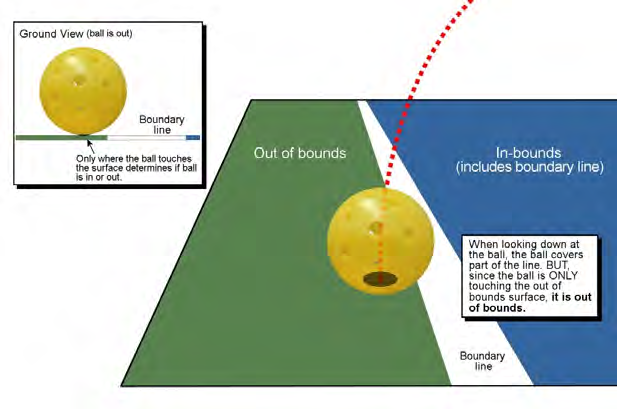
8.E Line Call Certainty. Players must not call a ball “out” unless they can clearly see a space between the line and the ball when it lands. (See Figure 8-1.)
Figure 8-1: Out Ball Illustration
8.F “Out” Call and Signal. Players must promptly signal an “out” ball audibly by voice, visibly by a hand signal, or both.
8.F.1 Valid Line Call. Any “out” call made by a player after the ball lands is a line call.
8.F.2 Dead Ball. A line call results in a dead ball and play must stop.
8.F.3 Out Call Timing. If a player returns the ball, their “out” call must be made before the ball is hit by the opponent or before the ball becomes dead; otherwise, play continues. If a player does not return the ball, an “out" call made promptly will be recognized, even if the ball becomes dead before the “out” call is made.
8.F.4 Partner Communication. While the ball is in the air, any communication between partners about whether a ball might land out is considered player communication, not a line call.
8.G Overriding a Call. Players may override a partner’s line call, their own line call, or an “in” ruling to their own disadvantage.
8.H Partner Disagreement (Doubles). When partners disagree on a line call, then conflict exists, and the team's call will be “in.”
8.I Requesting Opponent’s Opinion. A player may defer to the opponent any line call that the player is responsible for making by asking the opponent’s opinion up until the next serve is hit. When the opponent makes a clear “in” or “out” decision, the opponent’s decision will stand. When the opponent does not make a definitive call, the player’s call will stand or when no call was made by the player, the ball will be considered “in.” After asking the opponent, the player and the player’s partner lose the opportunity to make the line call, except to override the call to favor the opponent.
8.J Spectator Involvement. Spectators must not be consulted on any call.
Section 9 Dead Balls, Faults, and Hinders
9.A Stopping a Rally. Any action that stops play results in a dead ball.
9.A.1 Fault – Stopping a Rally. When a player stops a rally before the ball otherwise becomes dead, it is a fault against the player unless the stoppage is to call a hinder (see Rule 9.C), to correctly identify a player position or server error (see Rule 5.C.1.a), or to ask for correction of an incorrect score before the return of serve (see Rule 6.F.1).
9.B Faults. A called fault or a fault committed by a player results in a dead ball.
9.B.1 Fault Occurrence. A fault only occurs while the ball is live, except for non-volley zone violations involving momentum. (See Rule 11.A.2.)
9.B.2 Fault Call Responsibility. Players are expected to call faults on themselves or on their partner as soon as the fault is committed or detected.
9.B.3 Calling Non-Volley Zone Faults and Service Foot Faults on Opponent. Players may only call non-volley zone faults and service foot faults on an opponent.
9.B.3.a Fault Call Timing. A fault should be called as soon as the claimed fault is committed or detected. The fault must be called before the serve is hit to begin the next rally.
9.B.3.b Disagreement Between Teams. When there is any disagreement between teams about a fault call, the rally must be replayed.
9.B.3.c Disagreement Between Partners. Any disagreement between partners on a fault call will be decided to the benefit of their opponents.
9.B.4 No Enforcement of Other Faults. If a player believes an opponent has committed any type of fault other than a non-volley zone fault or a service foot fault, they may mention the specific fault to the opponent upon completion of the rally, but they have no authority to enforce the fault. The final decision on fault resolution belongs to the player that allegedly committed the fault.
9.C Hinders. A called hinder results in a dead ball.
9.C.1 Who Can Call Hinder. Any player may call a hinder.
9.C.2 Replay – Hinder. When a hinder is called, the rally must be replayed.
Section 10 Rally Situations
10.A Two-Bounce Rule. The serve and the return of serve must each bounce before being returned.
10.A.1 Fault – No Bounce by Receiver. When the receiver does not allow the serve to bounce before hitting the ball, it is a fault against the receiver.
10.A.2 Fault – No Bounce by Serving Side. When the server or server’s partner does not allow the return of serve to bounce before hitting the ball, it is a fault against the serving side.
10.B Maximum Number of Bounces. A player must return the ball before a second bounce.
10.B.1 Fault – Double Bounce. When a player fails to return a ball before it bounces twice, it is a fault against the player.
10.C Returned Ball Placement. A player must return the ball so that the ball lands on the opponent’s end of the court or contacts the opponent or anything that is worn or carried by the opponent before the ball lands.
10.C.1 Fault – Ball Lands Out of Bounds. When a player hits a ball that first lands outside the opponent’s end of the court, it is a fault against that player.
10.C.2 Fault – Ball Lands on Player’s Side of Net. When a player hits a ball that fails to cross the net and lands on the player’s side of the net, it is a fault against that player.
10.C.3 Fault – Ball Hits Player. After the serve, when the ball contacts a player or anything that is worn or carried by the player, except the player’s paddle or the player’s hands below the wrist joint while in contact with the paddle, it is a fault against that player.
10.C.4 Fault – Ball Hits Permanent Object Before Landing. When a player hits a ball that contacts a permanent object before bouncing on the court, it is a fault against that player.
10.C.5 Fault – Ball Hits Permanent Object After Landing. When a player fails to return a ball that has bounced in the player’s court before the ball contacts a permanent object, it is a fault against that player.
10.D Double Hit. Balls can be hit more than once, but the stroke must be continuous in a single direction by one player.
10.D.1 Fault – Double Hit. When a player hits a ball more than once using a stroke that is not continuous and in a single direction, it is a fault against that player.
10.D.2 Fault – Ball Hit by Two-Players. It is a fault if both a player and their partner strike the ball while attempting to return it.
10.E Missed Shot. When a player completely misses hitting the ball, the ball remains live.
10.F Distraction. A player must not distract their opponent when the opponent is about to hit the ball.
10.G Damaged Ball. When a ball is or becomes broken, cracked, soft or degraded, play must continue until the end of the rally. The ball will be replaced if all players agree.
10.G.1 Replay – Broken or Cracked Ball. When all players agree that a broken or cracked ball affected the outcome of the rally, the rally must be replayed. If all players do not agree that a broken or cracked ball affected the outcome of the rally, the result of the rally stands.
10.G.2 No Replay – Soft or Degraded Ball. When a ball is or becomes degraded or soft, the result of the prior rally stands.
10.H Injury. If a player is injured during a rally, play must continue until the end of the rally.
10.I Player Equipment or Apparel Problem. If a player experiences an equipment or apparel problem during a rally, play must continue until the end of the rally.
10.J Item on Court. When anything that is worn or carried by a player lands on the player’s end of the court (except when the item contacts the non-volley zone as a result of the player volleying the ball (see Rule 11.A.1)), the ball remains in play, even if the ball hits the item.
10.K Between Rallies. Players may quickly hydrate, towel off, and adjust equipment and apparel between rallies as long as the flow of the game is not adversely impacted.
Section 11 Non-Volley Zone Infractions
11.A Allowable Contact. All volleys must be initiated outside of the non-volley zone. A player, or anything in contact with the player, may contact the non-volley zone at any time except during the act of volleying a ball.
11.A.1 Fault – Non-Volley Zone Contact While Volleying. When a volleying player or anything that has contact with the volleying player (including the player’s partner) contacts the non-volley zone, it is a fault against the player.
11.A.2 Fault – Non-Volley Zone Momentum. When a volleying player’s momentum causes the player to contact anything (including the player’s partner) that is in contact with the non-volley zone, even after the ball becomes dead, it is a fault against the volleying player.
11.A.3 Fault – Failure to Exit the Non-Volley Zone Before Volleying. After contacting the non-volley zone, when a player volleys a ball before both feet contact the playing surface completely outside the non-volley zone, it is a fault against the player.
Section 12 The Paddle During Play
12.A One Paddle. A player must not use or carry more than one paddle during a rally.
12.A.1 Fault – More Than One Paddle. When a player uses or carries more than one paddle while the ball is in play, it is a fault against the player.
12.B Paddle Possession. A player must have possession of the paddle when hitting the ball. A player is allowed to hold the paddle with one or both hands. The paddle may be switched from hand to hand at any time.
12.B.1 Fault – Paddle Not in Possession. When a player does not have possession of the paddle when hitting the ball, it is a fault against the player.
12.C Catch or Carry. A player must not catch or carry a ball on their paddle during a rally.
12.C.1 Fault – Catch or Carry. When a player catches or carries a ball on their paddle during a rally, it is a fault against the player.
Section 13 The Net and Net Support System During Play
13.A Ball Contacting Net. When the ball contacts the net, or the rope or cable at the top of the net between the net posts, the ball remains in play.
13.A.1 Replay – Ball Contacts Net. When a returned ball that crosses the net gets caught in the net, contacts a part of the net that is draping on the ground, or contacts a deflecting net before or after bouncing, the rally must be replayed.
13.B Ball Contacting Net Support System. A served ball must not contact any part of the net support system. A returned ball must not contact any part of the net support system on the hitting player’s end of the net.
13.B.1 Fault – Ball Contacts Net Support System. When a player serves a ball that contacts the net support system on either end of the net or returns a ball that contacts the net support system before going over the net, it is a fault against the player.
13.B.2 Replay – Ball Affected by Net Support System. When a returned ball crosses the net and contacts any part of a crossbar, or any other part of the net support system within the court boundaries, before or after the ball bounces, the rally must be replayed.
13.C Ball Around Net Post. A ball may be returned around the outside of the net post.
13.D Ball Between Net and Net Post. A ball must not be hit between the net and the net post.
13.D.1 Fault – Ball Between Net and Net Post. When a player hits the ball between the net and the net post, it is a fault against the player.
13.E Ball Under Net. A ball must not be hit under the net.
13.E.1 Fault – Ball Under Net. When a player hits the ball under the net, it is a fault against the player.
13.F Ball Crossing Plane of Net. A ball must entirely cross to a player’s end of the net before the player hits the ball.
13.F.1 Fault – Ball Hit Before Crossing Plane of Net. When a player hits the ball before the ball entirely crosses the plane of the net to the player’s end, it is a fault against the player.
13.G Player Contacting Net or Net Support System. A player or anything that is worn or carried by the player must not contact the net or net support system while the ball is live.
13.G.1 Fault – Player Contacts Net or Net Support System. When a player or anything that is worn or carried by the player contacts the net or net support system while the ball is live, it is a fault against the player.
13.H Player Contacting Opponent or Opponent’s Court. A player or anything that is worn or carried by the player must not contact their opponent or the opponent’s end of the court while the ball is live.
13.H.1 Fault – Player Contacts Opponent or Opponent’s Court. When a player or anything that is worn or carried by the player contacts their opponent or the opponent’s end of the court while the ball is live, it is a fault against the player.
13.I Player Crossing Plane of Net. A player or anything that is worn or carried by the player must not cross the plane of the net when the ball is live, except as provided for in Rules 13.I.1 and 13.I.2.
13.I.1 After Hitting the Ball. A player may cross the plane of the net immediately after hitting the ball. The allowance to cross the plane of the net only applies while executing the current strike of the ball and for continuation associated with the current strike of the ball.
13.I.1.a Fault – Player Crosses Plane of Net Before Hitting Ball. When any part of a player or anything that is worn or carried by the player crosses the plane of the net before the player hits the ball, it is a fault against the player.
13.I.1.b Fault – Player Crosses Plane of Net Without Hitting Ball. When any part of a player or anything that is worn or carried by the player crosses the plane of the net and the player does not hit the ball, it is a fault against the player.
13.I.2 Ball Crosses Back to Opponent’s Side. When a ball bounces in the court on the receiving player’s end of the net and then returns to the opponent’s side of the net without being hit, the receiving player may cross over, under, or around the net to hit the ball, but only after the ball has first crossed back to the opponent’s end of the net.
13.I.2.a Fault – Player Crosses Plane of Net Before Ball Crosses. When a ball bounces in the court on the receiving player’s end of the net and is returning to the opponent’s end without being hit, it is a fault against the player if the player crosses the plane of the net before the ball crosses entirely.
13.I.2.b Fault – Ball Not Contacted. When a ball bounces in the court on the receiving player’s end of the net and then returns to the opponent’s end of the net without being hit, it is a fault against a player who fails to hit the ball before it bounces once on the opponent’s end of the net.
13.J Replay – Net System Malfunction. When a net system malfunctions during a rally, the rally must be replayed.
Section 14 Variations on Standard Pickleball
14.A (Provisional Rule) Rally Scoring Option. Rally scoring may be used for singles and doubles.
14.A.1 Applicability of Rules. All standard rules for singles and doubles apply except for the modifications included in this section.
14.A.2 Point Scoring. A point is scored by the singles player or doubles team that wins each rally. (Modifies Rule 4.A)
14.A.3 Calling the Score. The score must be called as two numbers: server’s score, then receiver’s score. (Modifies Rule 6.B.2)
14.A.4 Serving (Doubles). After each side out, service begins with the player correctly positioned on the right side according to the team’s score. The server will alternate serving areas after each point is won, until a rally is lost . (Modifies Rule 5.B.2)
14.A.5 One Server (Doubles). Only one player on a team will serve before a side out is declared. After the serving team loses the rally, a side out will occur, and service is awarded to the opponent. (Modifies Rules 5.B, 5.B.2, 5.B.5, 5.B.6)
14.B Mini-Singles. All standard singles rules apply to mini-singles except for the modifications included in this section.
14.B.1 The Court. Mini-singles is played on a standard pickleball court. (See Figure 3-1.)
14.B.1.a Court Area In Play. Only the right or left side on each player’s end of the court is in play during each rally based on each player’s respective score. (Modifies Rules 3.A.4.c, 5.A.1)
14.B.1.b Boundary Lines. The boundary lines of the in-play side of the court for a rally are the baseline, the respective sideline, and the centerline of the court. The opposite side of the court is out of bounds.
14.B.1.c Additional Court Line. An additional line must be provided that extends the centerline of the court through each non-volley zone. The color of the additional line is not required to be the same as the other court lines. (Modifies Rule 3.A.4.d)
14.B.2 Player Positions. The server’s and the receiver’s correct positions for a rally are determined by their individual scores. (Modifies Rule 5.A)
14.B.3 Shot Placement. Each player’s served and returned balls must land in bounds of the opponent’s side of the court that is in play.
Part III Tournament Play
Part III (Sections 15 through 24) presents additional rules, and modifications to rules in Part II, that apply to tournament play only.
Section 15 Tournament Event and Scoring Options
15.A Event Categories.
Men’s: Singles and Doubles
Women’s: Singles and Doubles
Mixed: Doubles
Wheelchair: Singles and Doubles (See Section 25.A) Adaptive Standing: Singles and Doubles (See Section 25.B) Hybrid: Doubles (See Section 25.C)
15.A.1 Gender Events. In events categorized by gender, only members of that gender are allowed to play in that event.
15.A.2 Open Gender and Age Events. Players of any gender and age are allowed to play in an open gender and age event.
15.A.3 Doubles. A doubles team must consist of two players who meet the classification requirements to participate in a particular division of play.
15.A.3.a Mixed Doubles. A mixed doubles team must consist of one male player and one female player.
15.A.3.b Skill-Rated Doubles Events. In a doubles event based on player skill rating, the skill level of the higher-rated team member determines a team’s skill rating for the event.
15.A.3.c Age-Qualified Doubles Events. In a doubles event qualified by ages 19 years and older (adult event), the age of the younger team member determines a team’s age classification for the event. Players may play in a younger age adult event unless prohibited by the rules of the National Senior Games Association.
15.A.4 Junior Events. Junior events are qualified by ages 18 and younger. Players aged 18 years and younger may play in any adult event
when a junior event is not available or does not have enough entrants, or with the Tournament Director’s permission.
15.B Event Formats. Matches may use any of the approved tournament formats.
15.B.1 Double Elimination. In a double elimination format, after losing one match, a singles player or doubles team plays in a consolation bracket. The player or team is eliminated from competition after one loss in the consolation bracket. The winner of the consolation bracket plays the winner of the winners’ bracket to determine first place and second place. If the winner of the consolation bracket defeats the winner of the winners’ bracket, then a tie-breaker match to 15 points must be played to determine first place and second place. The loser of the final match in the consolation bracket wins third place.
15.B.2 Single Elimination with Consolation. In a single elimination with consolation format, after losing one match, a singles player or doubles team plays in a consolation bracket. The player or team is eliminated from competition after one loss in the consolation bracket. The final two players or teams in the winners’ bracket play for first place and second place. The final two singles players or doubles teams in the consolation bracket play for third place.
15.B.3 Single Elimination Without Consolation. (Pro and Senior Pro Player Brackets) Single Elimination Without Consolation. The first player/team to score the match-winning point by at least a two-point margin wins. The final two players/teams in the winner’s bracket play for the gold/first place and silver/second-place medals. The determination of the final standings of the remaining players/teams is left to the discretion of tournament officials.
15.B.4 Round Robin. All singles players or doubles teams play each other. The winner is determined based on the highest number of matches won. When two or more teams are tied for the number of matches won, ties must be broken in accordance with the sequence in Rules
15.B.4.a through 15.B.4.f. The method that succeeds in breaking the tie will be used to rank all tied teams.
15.B.4.a Withdrawal, Retirement, or Forfeit. When a singles player or doubles team withdraws, retires, or is forfeited from a round robin event, then that player’s or team’s match results will not count toward the standings of that event and the player or team will not be eligible to participate in any elimination playoff or
medal match for that event. The match results will count towards the player’s or team’s rating.
15.B.4.b First Tie-Breaker. The first tie-breaker is the best record of head-to-head matches among the tied teams.
15.B.4.c Second Tie-Breaker. The second tie-breaker is the best point differential of all games played. This tie-breaker does not apply across multiple pools where the number of teams in each pool is not equal. (For example, Team A wins their first match, 11-8, 11-4, so they would have a point differential of +10. Team A then wins the second match, 11-9, 2-11, 11-6. For the second round, they would have a point differential of -
This would give them a total for the two rounds of +8.)
15.B.4.d Third Tie-Breaker. The third tie-breaker is the best point differential of head-to-head games.
15.B.4.e Fourth Tie-Breaker. The fourth tie-breaker is the best point differential of games played against the singles player or doubles team with the next -highest number of matches won. (For example, when players or teams are tied for second-place, the total point differential against the first-place singles player or doubles team is used.)
15.B.4.f Fifth Tie-Breaker. The fifth tie-breaker is the highest number of points scored across all matches in the round robin. This tie-breaker does not apply across multiple pools where the number of teams in each pool is not equal.
15.B.5 Pool Play. The singles players or doubles teams are divided into two or more player pools. Each pool plays a round robin to seed the players or teams for a single-elimination or double-elimination playoff.
15.B.6 Non-Pool Play. After playing a round robin to determine seeding, seeded singles players or doubles teams play a single-elimination or double-elimination playoff, using a match format of two of three games to 11 points, one game to 15 points, or one game to 21 points, all win by two points.
15.B.7 Team Play. Team play participants are designated by roster and play can include gender singles, gender doubles, and mixed doubles. Team play may use standard scoring or rally scoring for both singles and doubles play.
15.C Tournament Match and Scoring Options. All scoring options are win by two points, except win by one point is allowed for team play.
15.C.1 Standard Scoring Formats. The tournament standard scoring options are:
15.C.1.a Best 2-of-3 games to 11 points.
15.C.1.b Best 3-of-5 games to 11 points.
15.C.1.c One game to 15 or 21 points.
15.C.1.d One game to 11 points (for round robin events with six or more teams only).
15.C.2 (Provisional Rule) Rally Scoring Match Formats. The Tournament Director has the option to use rally scoring except for double-elimination doubles events, all 2026 USA Pickleball Golden Ticket events, and the 2026 USA Pickleball National Championship events. The tournament rally scoring options are:
15.C.2.a One game to 11 points, 15 points, or 21 points.
15.C.2.b Best 2-of-3 games to 11 points, 15 points, or 21 points.
15.C.2.c Best 3-of-5 games to 11 points, 15 points, or 21 points.
15.C.2.d For inclement weather considerations, the Tournament Director may approve game scoring to 7 points with an end change at 4 points in a single-game match or the tie-breaker game of a multiple-game match.
15.D Scheduling Matches. A player is not permitted to enter multiple events scheduled on the same day with an overlapping time duration.
15.E Draws and Seeding. A draw and seeding committee must rank the players and teams and set up a fair draw in each event.
15.F Two-Match Minimum. Each player is entitled to participate in a minimum of two scheduled matches per event entered except for a Single Elimination Without Consolation event. (See Rule 15.B.3.)
15.G Error Corrections. Tournament Operations personnel have the authority to correct any operational errors that result in incorrect scores, players on courts, match results, bracket results, medal results, matches being played, or future matches to be played.
Section 16 Tournament Director Responsibilities
16.A Overall Responsibility. The Tournament Director is responsible for the tournament, designates the officials and their areas of responsibility, and ensures that planned support is available.
16.B Designee Selection. The Tournament Director may designate a representative to assume certain Director duties, but the Tournament Director retains final decision-making authority.
16.C Event Formats. The Tournament Director or the tournament sponsor typically selects the event formats. (See Rule 15.B.)
16.D Draw and Seeding Committee. The Tournament Director must appoint a draw and seeding committee. (See Rule 15.E.)
16.E Notification of Hazards and Abnormal Conditions. Before the tournament, the Tournament Director must notify players and referees of any unique features, abnormal local conditions, or hazards associated with the courts. When possible, players should be notified in writing as part of the pre-tournament instructions. Referees must be notified at the venue.
16.F Local Rules and Exceptions. The Tournament Director must not implement or impose any rule that is not provided in this Rulebook. Exceptions to the rules because of physical limitations of the courts or other local conditions must be approved in advance of the tournament by the USA Pickleball Managing Director of Officiating.
16.G Ball Selection. The Tournament Director will choose the tournament ball from the official list of approved balls posted on the USA Pickleball website.
16.H Starting Server Identification (Doubles). The Tournament Director will provide a method of identifying each team’s starting server for each game.
16.I Line Judges. The Tournament Director will determine which matches will use line judges.
16.J Removal of Referee or Line Judge. The Tournament Director has the final authority to remove and replace members of the officiating team. (See Rules
20.K and 20.L.)
16.K Player Apparel Changes. The Tournament Director has the authority to require players to change apparel. (See Rule 18.B.3 and 18.B.4.)
16.L Notice of Schedule Changes. When any change is made to the tournament schedule of matches after the initial posting, the Tournament Director must notify the players of the changes.
16.M Extending Time to Report to Match. The Tournament Director may allow an extension of time for players to report to a match when circumstances warrant.
16.N Court Changes. The Tournament Director may direct a court change during a match after the completion of any game to accommodate better spectator or playing conditions.
16.O Officiating Appeals. The Tournament Director must resolve player appeals concerning officiating rulings. Decisions of the Tournament Director are final.
16.P Player Misconduct. The Tournament Director has the authority to impose warnings, technical fouls, and match forfeits and to eject or expel any player for misconduct. (See Rules 22.A.3, 22.I and 22.K)
16.Q Partner Changes. The Tournament Director must approve any allowable doubles partner changes. (See Rule 18.G.)
Section 17 Referee Responsibilities
17.A Basic Duties. The referee is responsible for all decisions related to procedural and judgment calls during a match.
17.B Pre-Match Checks. Before each match starts, the referee must:
17.B.1 Referee Tools. Check the availability and suitability of necessary supplies for the match, such as balls, scoresheets, pencils, and a timing device.
17.B.2 Court Conditions. Check the preparation of the court with respect to cleanliness, lighting, net height, court markings, and hazards.
17.C Pre-Match Briefing. Before each match starts, the referee must meet with the players at the court to:
17.C.1 Paddle Inspection. Inspect paddles for compliance with paddle specifications. (See Rules 3.D, and 18.A.)
17.C.2 Rule Modifications and Hinders. Point out approved rule modifications, court abnormalities, and non-standard court conditions that could be potential safety issues.
17.C.3 Line Calling Duties. Instruct players on the line calling duties of the referee, players, and line judges when applicable. This requirement may be satisfied by the Tournament Director providing pre-match instructions to the players. (See Section 19.)
17.C.4 Selection of Service and End. Use a fair method (e.g., selection of a number [1 or 2] written on the back of the scoresheet, coin toss) to determine which singles player or doubles team has first choice of serving, receiving, selecting at which end of the court to start the match, or deferring the first choice to their opponent. Once a selection is made, it cannot be changed.
17.C.5 Starting Server Identification (Doubles). Ensure the starting server for each team wears the required identification. (See Rule 18.C.)
17.D Officiating Play. During the match, the referee must:
17.D.1 Player and Position Confirmations. Confirm the correct server, receiver, and player positions and correct the players if necessary.
17.D.2 Score Calls. Call the score to start each rally after confirming that the correct server has the ball (see Rule 6.B). Calling the score indicates to all players that play is ready to resume.
17.D.2.a Serving Area Change. Allow players to reposition when the serving team changes serving areas after the score has been called, and then re-call the score. (See Rule 20.D.)
17.D.3 Point Calls. Call “point” after each point is awarded.
17.D.4 Second Server Calls (Doubles). Call “second server” (or “second serve”) after the first server’s team loses a rally.
17.D.5 Side Out Calls. Announce “side out” when a singles player or second server loses the serve.
17.D.6 Scoresheet Annotations. Appropriately annotate the scoresheet after a rally is completed or a time-out is called.
17.D.7 Net Checks. Recheck the net height and position if the net is disturbed.
17.D.8 Fault Calls. Identify and call rule violations when they occur.
17.D.9 Replay Calls. Call replays as appropriate. (See Appendix A.2.)
17.D.10 Line Calls. Assist with line calls upon appeal and when a line judge signals a blocked view. (See Section 19.)
17.D.11 Appealed Calls. Rule on other calls appealed by players. The referee may consult players and line judges to decide the outcome of any appeal.
17.D.12 Line Judges. Monitor and manage line judge performance. (See Rule 20.K.)
17.D.13 Hinders. Calls hinders and determines the validity of player-called hinders. (See Rule 20.H.)
17.D.14 Damaged Balls. Determine whether a ball is broken or cracked and must be replaced, and whether the broken or cracked ball affected the outcome of a rally. (See Rule 20.F.)
17.D.15 Time-Outs. Enforce time-out procedures. (See Section 21.)
17.D.16 15-Second Warnings. Announce when there are 15 seconds remaining in a time-out. At the end of the 15 seconds, the referee
must call “time in” and then the score when all players are ready to play or should be ready to play.
17.D.17 Player Conduct. Monitor and manage player conduct. The referee is empowered to call verbal warnings, technical warnings, and technical fouls, and to forfeit games and matches based on a defined combination of technical warnings and/or technical fouls. The referee may also recommend ejection of a player to the Tournament Director. (See Section 22.)
Section 18 Player Pre-Match
18.A USA Pickleball Approved Paddle. Players must use an approved paddle that complies with the paddle specifications in Rule 3.D. Players must confirm that their paddle is approved and listed on the USA Pickleball Approved Paddle List.
18.A.1 Non-Compliant Paddle Discovered Before Match Starts. Before a match starts, when a player is discovered using a paddle that is not listed on the USA Pickleball Approved Paddle List or is not in compliance with the paddle specifications in Rule 3.D, the player must switch to a compliant paddle. There is no penalty to switch paddles.
18.A.2 Match Forfeit – Non-Compliant Paddle Discovered During Play. During a match, when a player is discovered playing with a paddle that is not listed on the USA Pickleball Approved Paddle List or is not in compliance with the paddle specifications in Rule 3.D, a match forfeit will be imposed on the player.
18.A.3 Non-Compliant Paddle Discovered After Match Concludes. After a match has ended, when a player is discovered to have used a paddle that is not listed on the USA Pickleball Approved Paddle List or is not in compliance with the paddle specifications in Rule 3.D, the match results stand.
18.B Apparel. Player apparel must comply with Rules 18.B.1 and 18.B.2.
18.B.1 Depictions. Graphics, insignias, pictures, and writing on apparel must be in good taste.
18.B.2 Footwear. Shoes must have soles that do not mark or damage the playing surface.
18.B.3 Apparel Change. A player must change apparel that is considered inappropriate by the Tournament Director, including that which approximates the color of the ball. A referee time-out will be used for an apparel change required during a match. (See Rule 16.K.)
18.B.4 Match Forfeit – Refusal to Change Apparel. When a player refuses to comply with the apparel rules, the Tournament Director may impose a forfeit of the player’s match.
18.C Starting Server Identification (Doubles). Starting servers must wear the required form of identification determined by the Tournament Director. This identification must be visible to the officiating team and players during play.
18.C.1 Match Forfeit – Refusal to Wear Identification. When a player refuses to wear the required form of identification, the Tournament Director may impose a forfeit of the player’s match.
18.D Electronic Equipment. During competition play, players may not wear or use headphones, earbuds, or any other equipment that enables audio communication, except for prescribed or required hearing aids.
18.E Notice of Matches. It is the responsibility of each player to check the posted schedules and notifications of schedule changes to determine the time and place of each match.
18.F Reporting for Match. Players must report to play a match within 10 minutes after the match is called. A match cannot begin until all players are present and the starting score is called.
18.F.1 Game or Match Forfeit – No Show for First Game. When a player fails to report to play within 10 minutes after the match has been called to play, the referee will impose a game forfeit on the player, unless the Tournament Director grants a delay of the match start for extenuating circumstances. If the match format is one game, the game forfeit will result in a match forfeit.
18.F.2 Match Forfeit – No Show for Multiple-Game Match. In a multiple-game match, when a player fails to report to play within 15 minutes after the match has been called to play, the referee will impose a match forfeit on the player, unless the Tournament Director grants a delay of the match start for extenuating circumstances. (See Rule 16.M.)
18.G Partner Change (Doubles). With the Tournament Director’s approval, a player may change a partner before a first-round match when the change is due to injury, illness, or circumstances beyond the control of the player. A partner change after the partners start team play is prohibited.
Section 19 Tournament Line Calls
19.A Match Officiating Options. Matches may be officiated by a referee with or without line judges.
19.A.1 Referee Responsibilities: The referee is responsible for calling service foot faults, short serves, and non-volley zone faults. (Modifies 9.B.4, first sentence)
19.B Matches Without Line Judges. In matches officiated by a referee without line judges, players are responsible for making “out” calls for the baseline, sidelines, and center service line on their end of the court.
19.C Matches with Line Judges. In matches officiated by a referee with line judges:
19.C.1 Line Judge Responsibilities. Line judges make line calls and foot fault calls for their assigned line and assist the referee with other calls as requested. Line judges will signify by loudly calling “out” (or “service foot fault”) and showing the “out” signal (outstretched arm pointing in the out- of-bounds direction).
19.C.2 Player Responsibilities. Players are responsible for making “out” calls for only the service court centerline on their end of the court.
19.C.3 Invalid Line Calls. Player line calls are not valid, except for their centerline and to override an official’s line call to favor the opponent.
19.D Appeals. Only rally-ending shots can be appealed. Any player may make the appeal.
19.D.1 Appeal Timing. The appeal must be made before the ball is hit to make the next serve. An appeal of a match-ending shot must be made before the scoresheet is initialed.
19.D.2 Requesting Opponent’s Opinion Before Appeal. Before appealing to the referee, a player may ask an opponent’s opinion on any line call the player is responsible for making. When the opponent is asked and the opponent makes a definitive call, the opponent’s call stands unless the referee overrules the opponent’s call on appeal or the player or their partner overrides the call to favor the opponent (Rule 19.I).
19.D.3 Loss of Opportunity to Make Line Call. After appealing to the referee or asking the opponent’s opinion on a line call, the player and the player’s partner lose the opportunity to make the line call, except to override the call to favor the opponent. (See Rule 19.I.)
19.E Referee Makes Call – Without Line Judges. In a match without line judges, when a player appeals a rally-ending shot to the referee, the referee must make the call when they clearly saw where the ball landed.
19.F Referee Overrule of Line Call. Upon appeal, the referee may overrule any line call by a player or a line judge. The referee must overrule the line call if the referee saw the ball land “in.”
19.F.1 Fault – Referee Overrule of Player’s “Out” Call. When the referee overrules an “out” call made by a player, it is a fault against that singles player or doubles team.
19.F.2 Replay or Concession – Referee Overrule of Line Judge’s “Out” Call. When the referee overrules a line judge’s “out” call as “in,” the rally must be replayed, unless the singles player or doubles team that benefits from the referee’s ruling concedes the rally to their opponent.
19.G No Definitive Call by Referee. When the referee is unable to make a call upon appeal, the outcome of the rally is determined by Rules 19.G.1 through 19.G.4.
19.G.1 No Call by Referee – Without Line Judges. When the referee is unable to make a call upon appeal, the player’s call stands, unless the player or the player’s partner asked the opponent and the opponent made a definitive call, in which case the opponent’s call stands. (See also Rule 19.D.2.)
19.G.2 No Call by Players and Referee – Without Line Judges. Upon appeal, when the players and the referee are unable to make a call, the ball is ruled “in.”
19.G.3 No Call by Referee – With Line Judges. When the referee is unable to make a call upon appeal, the line judge’s call stands.
19.G.4 Replay – No Call by Officiating Team. When the line judges and referees are unable to make a call, the rally must be replayed.
19.H Immediate Call by Referee. If a line judge shows the “blocked/blinded” signal at any time, the referee must make the call immediately if they clearly saw where the ball landed. If the referee cannot make the call on a
rally-ending shot, the referee must canvass other appropriate members of the officiating team to assist in making the call.
19.I Player Override of Call. A player may override an official’s line call, their partner’s line call, their own line call, or any “in” ruling when the override favors the opponent.
19.I.1 Replay or Concession – Player Override of Official’s “Out” Call. When a player disagrees with a line judge’s or a referee’s “out” call that favored the player, the rally must be replayed, unless the player concedes the rally to their opponent.
19.I.2 Player Override of Official’s “In” Ruling. When a player disagrees with a line judge’s or a referee’s ruling of an “in” ball that favored the player, the opponent wins the rally. (See also Rule 8.G.)
Section 20 Tournament Match Situations
20.A Confirmation of Score. Before the serve is hit, any player may ask the referee for the correct score. (Modifies Rule 6.E)
20.B Confirmation of Correct Player or Position. Before the serve is hit, any player may ask the referee to confirm the correct server, correct receiver, and correct player positions. (Modifies Rule 5.C)
20.C Replay – Server or Position Correction. When the referee stops a rally to identify a player or position error, the rally must be replayed.
20.D Player Repositioning. After the score is called, when the serving team changes serving areas, the referee must stop play, allow all players to reposition, and re-call the score to restart the 10-second count. (Modifies Rule 6.D.2)
20.E Service Faults and Replays. Service faults or replays will be called in accordance with Rule 20.E.1 or Rule 20.E.2.
20.E.1 Faults. In addition to the violations cited in Section 7, the referee will call faults for service violations.
20.E.1.a Fault – Volley Serve, No Upward Service Motion. When the server’s arm is not clearly moving in an upward arc when the paddle contacts the ball, it is a fault against the server.
20.E.1.b Fault – Volley Serve, Paddle Head Above Wrist. When the highest point of the paddle head is clearly above the server’s wrist joint when the paddle contacts the ball, it is a fault against the server.
20.E.1.c Fault – Volley Serve, Ball Contacted Above Waist. When the ball is clearly above the server’s waist when the paddle contacts the ball, it is a fault against the server.
20.E.1.d Fault – Volley Serve and Drop Serve, Release from Hands and Paddle. When the server does not clearly release the ball from only one hand or only from the paddle immediately prior to the serve, it is a fault against the server.
20.E.1.e Fault – Volley Serve and Drop Serve, Spin or Manipulation on Release. When the server
manipulates or spins the ball immediately prior to the serve, it is a fault against the server.
20.E.1.f Fault – Drop Serve, Force Added to Ball Release. When the server propels the ball in any direction or manner prior to hitting the ball to make a drop serve, it is a fault against the server.
20.E.1.g Fault – Drop Serve, Ball Release Aided Height. When the server does not clearly release the ball from a natural (un-aided) height, it is a fault against the server.
20.E.2 Replays. The referee has the authority to call for a replay when they are not certain that one or more of the requirements of the serve has been met. Replays must be called before the return of serve.
20.E.2.a Replay – Ball Release Not Visible. When it is questionable whether the release of the ball was not visible to the referee and receiver, the referee may call for a replay. When the referee is certain that the release of the ball was not visible, the referee must call for a replay.
20.E.2.b Replay – Questionable Release From One Hand, Paddle or Natural Height. When it is questionable whether the server released the ball from only one hand or only from the paddle, or whether the release on a drop serve was from a natural (un-aided) height, the referee may call for a replay.
20.E.2.c Replay – Questionable Manipulation or Spin. When it is questionable whether the server imparted manipulation or spin during the release of the ball, the referee may call for a replay. (Modifies Rule 7.B.2.a)
20.E.2.d Replay – Questionable Foot Contact with Serving Area. When it is questionable whether either of the server’s feet were in contact with the serving area when the paddle contacted the ball, the referee may call for a replay.
20.E.2.e Replay – Questionable Foot Contact Outside the Serving Area. When it is questionable whether either
of the server’s feet were in contact with the playing surface outside the serving area when the paddle contacted the ball, the referee may call for a replay.
20.E.2.f Replay – Volley Serve, Questionable Upward Service Motion. When it is questionable whether the server’s arm was moving in an upward arc when the paddle contacted the ball to make a volley serve, the referee may call for a replay.
20.E.2.g Replay – Volley Serve, Questionable Paddle Head Height. When it is questionable whether the highest point of the paddle head was no higher than the server’s wrist joint when the paddle contacted the ball to make a volley serve, the referee may call for a replay.
20.E.2.h Replay – Volley Serve, Questionable Ball Height. When it is questionable whether the ball was no higher than the server’s waist when the paddle contacted the ball to make a volley serve, the referee may call for a replay.
20.E.2.i Replay – Drop Serve, Questionable Force on Ball. When it is questionable whether the ball was propelled when the server released the ball to make a drop serve, the referee must call for a replay.
20.F Damaged Ball. A player may appeal to the referee to determine whether a ball is degraded, soft, broken, or cracked. A potentially soft or degraded ball will not be replaced unless all players agree. If the referee determines that the ball is broken or cracked, it will be replaced. (Modifies Rule 10.G)
20.F.1 Replay – Broken or Cracked Ball. When the referee determines that the broken or cracked ball affected the outcome of the rally, the rally must be replayed with a replacement ball. (Modifies Rule 10.G.1)
20.G Coaching. Except during time-outs and between games, players or teams must not receive coaching from anyone other than a partner.
20.G.1 Verbal Warning or Technical Warning – Illegal Coaching. The referee may assess a verbal warning or technical warning against a singles player or doubles team that receives coaching other than during time-outs or between games.
20.H Hinder. The referee must validate a hinder called by a player. (Modifies Rule 9.C.2)
20.H.1 Fault – Invalid Hinder. When the referee does not validate a hinder called by a player, it is a fault against the player.
20.H.2 Replay – Valid Hinder. When the referee validates a hinder called by a player, the rally must be replayed. (Modifies Rule 9.C.2)
20.I Distraction. The referee must determine when a player has distracted their opponent from hitting the ball.
20.I.1 Fault – Distraction. When, in the judgement of the referee, a player distracts an opponent when the opponent is about to hit the ball, it is a fault against the player.
20.J Officiating Decision Challenge. Players may appeal any officiating decision to the Head Referee or Tournament Director.
20.J.1 Rescinding Challenge Request. After a request for the Head Referee or Tournament Director has been acknowledged by the referee, the player may rescind the request; however, the player or team will be charged a standard time-out. When a standard time-out is not available, the referee will assess a technical foul against the player or team.
20.J.2 Technical Warning or Technical Foul – Correct Ruling by Referee. When the Head Referee or Tournament Director concurs with a referee’s ruling, the referee will assess a technical warning and charge a standard time-out against the singles player or doubles team that challenged the ruling. When a standard time-out is not available, the referee will assess a technical foul against the player or team.
20.J.3 Referee’s Ruling Overturned. When the Head Referee or Tournament Director does not concur with a referee’s ruling, the referee must reverse the ruling to correct the situation or order a replay of the rally, as appropriate.
20.K Removal of Line Judge. The referee may remove and replace a line judge for any reasonable cause based on the referee's own observation or the unanimous request of the players.
20.K.1 Player Request. When all players agree, they may petition the referee to have a line judge removed.
20.K.2 Referee Disagreement. When the referee disagrees with the players’ request to remove a line judge, the referee must summon the Tournament Director for a final decision.
20.L Removal of Referee. When all players agree, they may petition the Tournament Director to have a referee removed.
Section 21 Time-Outs and Breaks
21.A Standard Time-Out. Two standard time-outs are allowed per singles player or doubles team for each 11-point and 15-point game and three time-outs for a 21-point game.
21.A.1 Before Start of Match. A standard time-out cannot be called before a match starts.
21.A.2 Requesting Time-Out. Any player may call a time-out between rallies before the next serve occurs or between games. The time-out must be called audibly by voice or visibly by hand signal, or both, and must be directed toward the opposing player or team and to the referee.
21.A.2.a Fault – Late Time-Out Request. When a player calls a time-out after the serve has been hit, it is a fault against that player.
21.A.2.b Verbal Warning or Technical Warning – No Audible or Visible Request. If the time-out call is not made audibly by voice or visibly by hand, the referee may assess a verbal warning or technical warning for delay of game.
21.A.3 Between Games. Between games, players may request to use one or both standard time-outs before the start of the next game. The players must inform the referee. The standard time-out will start immediately after the expiration of the time-out between games. A time-out must be charged when any portion of the time is used. When the requesting singles player or doubles team is ready to resume play before a requested time-out begins, that time-out is not charged.
21.A.4 After Medical Time-Out. A player may use available standard time-outs after the expiration of a medical time-out.
21.A.5 Duration. A maximum of one minute is allowed for each standard time-out.
21.A.6 Resuming Play. The referee will resume play by announcing a 15-second warning (Rule 17.D.16).
21.B End Change Time-Out. The referee will call a time-out to allow players to change ends at specified points during single-game matches and tie-
breaker games. Players will not change ends during the tie-breaker game when the first game of the match was forfeited due to late arrival.
21.B.1 11-Point Game. In a single game or tie-breaker game to 11 points, the players will change ends when the first singles player or doubles team reaches a score of 6.
21.B.2 15-Point Game. In a single game or tie-breaker game to 15 points, the players will change ends when the first singles player or doubles team reaches a score of 8.
21.B.3 21-Point Game. In a single game or tie-breaker game to 21 points, the players will change ends when the first singles player or doubles team reaches a score of 11.
21.B.4 No Server Change. After an end change time-out, play continues with the same server.
21.B.5 Duration. A maximum of one minute is allowed to change ends during a game.
21.B.6 Loss of End Change Point. A technical foul resulting in the loss of the end change point will have no effect on the completed end change.
21.B.7 Failure to Change Ends. When an end change is not executed at the required point score, the end change will be executed when the failure to change ends is detected. It is not a fault on either team, the score is not impacted, and service continues with the same server.
21.B.8 Resuming Play. The referee will resume play by announcing a 15-second warning (Rule 17.D.16).
21.C Medical Time-Out. A player needing medical attention during a match, including between games, may request a medical time-out.
21.C.1 Before Start of Match. A medical time-out cannot be called before the start of a match.
21.C.2 Between Games. Between games, a player may request a medical time-out, when available, before the start of the next game.
21.C.3 Number Available. A player may be granted only one medical time-out per match.
21.C.4 Rescinding Medical Time-Out Request. If the player rescinds the medical time-out after the medical personnel have been called and before they have arrived, a standard time-out will be charged and the medical time-out will not be charged. When a standard time-out is not available, the referee will assess a technical foul against the player or team for delay of game.
21.C.5 Summoning Medical Assistance. The referee will immediately summon on-site medical personnel to assess the situation and render appropriate first aid. When medical personnel are not available, the Tournament Director will be summoned for assistance.
21.C.6 Duration. A maximum of 15 minutes is allowed for a medical time-out. However, when medical treatment is rendered off-court at another location at the venue, the time to transport the player to and from the off-court location will be excluded from 15-minute time period.
21.C.7 Time Start. When medical assistance arrives, the referee will start a 15-minute timer. Play must resume as soon as possible but no later than 15 minutes of elapsed time.
21.C.8 Valid Medical Condition. When medical personnel, or the Tournament Director, when medical personnel are not available, determine that a valid medical condition exists, the player must be able to resume play in 15 minutes or less. When the player is able to resume play in fewer than 15 minutes, the remaining medical time is lost and no longer available to the player during the match.
21.C.9 Match Retirement. A match retirement is imposed when a player is not able to continue play after the 15-minute medical time-out period expires. A player may use their available standard time-outs to allow more time before the match must be retired (Rule 21.A.4). In doubles, if the retiring player's partner decides to continue, the match will resume following all applicable rules. The retiring player must leave the playing surface.
21.C.10 Technical Warning or Technical Foul – Invalid Medical Condition. When medical personnel, or the Tournament Director when medical personnel are not available, determine that no valid medical condition exists for granting a medical timeout, the referee will assess a technical warning and charge
a standard time-out against the singles player or doubles team that requested the medical time-out. When a standard time-out is not available, the referee will assess a technical foul against the player or team. The medical time-out is no longer available to that player and the player must resume play immediately.
21.C.11 Resuming Play. The referee will resume play by announcing a 15-second warning (Rule 17.D.16).
21.D Referee Time-Out. The referee may call a referee time-out to address extenuating circumstances that require an extended interruption of play and summon assistance, as necessary. When designated personnel are not available, the Tournament Director will respond. Extenuating circumstances include, but are not limited to, those cited in this section.
21.D.1 Referee Discretion. In the interest of overall safety, when the referee determines a potential medical situation exists, the referee is authorized to call a referee time-out and summon medical personnel, or the Tournament Director when medical personnel are not available.
21.D.2 Presence of Blood. When a player is actively bleeding or blood is found on the court or a player, play must be stopped at the end of the rally. Play must not resume until the blood has been cleaned up and the bleeding has been controlled. Issues relating solely to blood cleanup or control that do not require the services of medical personnel will be addressed as a referee time-out.
21.D.3 Foreign Substances. Foreign substances on the court, such as debris, water, or other fluids, must be removed or cleaned up.
21.D.4 Resuming Play. The referee will resume play by announcing a 15-second warning (Rule 17.D.16).
21.E Equipment Time-Out. Players are expected to keep all apparel and equipment in playable condition.
21.E.1 Time-Out Award. When the referee determines that an equipment change or adjustment is necessary for fair and safe continuation of the match, the referee may award an equipment time-out of reasonable duration.
21.E.2 Resuming Play. The referee will resume play by announcing a 15-second warning (Rule 17.D.16).
21.F Time-Out Between Games. The referee will call a time-out between games of a match.
21.F.1 Duration. A maximum of two minutes is allowed to change ends between games.
21.F.2 End Change and Initial Service Change. Singles players or doubles teams must change ends and initial service for the next game of the match.
21.F.3 Change of Starting Server. Teams may change the starting server between games and should notify the referee before the start of the next game.
21.F.4 Resuming Play. The referee will resume play by announcing a 15-second warning (Rule 17.D.16).
21.G Time Between Matches. The allowed time between matches, including a tie-breaker match to determine a championship, is 10 minutes. When all players agree, a match may start early.
21.H Suspended Game. A game suspended due to extenuating circumstances must resume with the same server, score, and remaining time-outs as when the game was suspended.
Section 23 Retirements and Withdrawals
23.A Retirement from Match. A singles player or doubles team may retire from a match for any reason. The only option to discontinue playing a match after the initial score has been called is retirement. Upon retirement, the match is awarded to the opponent.
23.A.1 Retirement During Match. A singles player or doubles team may retire before the end of any match being played by notifying the referee.
23.A.2 Advance Notification of Retirement. A singles player or doubles team may request a retirement in advance of any upcoming match by notifying the Tournament Director, Head Referee, or operations desk personnel.
23.A.3 Eligibility to Continue Play. A singles player or doubles team that retires from a match may continue play in the same bracket if eligible based on the event format.
23.A.4 Scoring for Retirement. When a singles player or doubles team retires from a match, the scores for all games and matches completed prior to retirement are retained. For a game in progress, the actual score of the retiring singles player or doubles team at the time of retirement must be recorded and the opponent will be awarded the required number of points to reflect a winning score for the game. Scores for games not played in a match, when appropriate, must be reported as 11-0 for games to 11 points, 15-0 for games to 15 points, or 21-0 for games to 21 points. (See Rule 15.B.4.a for a round robin.)
23.B Withdrawal from Bracket. Players may withdraw from a bracket by notifying the Tournament Director, Head Referee, or operations desk personnel.
23.B.1 Withdrawal Before Start of Bracket. A singles player or doubles team may withdraw from a bracket that has not started play.
23.B.2 Withdrawal from Upcoming Matches. A singles player or doubles team may withdraw from all remaining matches in a bracket prior to the initial score being called to start their next match.
23.B.3 Ineligibility to Continue Play. A singles player or doubles team that withdraws is removed from all upcoming matches in the specified bracket.
23.B.4 Scoring for Withdrawal. When a singles player or doubles team withdraws from a bracket, the scores for each game of each match not played are reported as 0-0. Scores for matches completed before the request for withdrawal are retained. (See Rule 15.B.4.a for a round robin.)
Section 24 Non-Officiated Tournament Play
NOTE: In non-officiated tournament play, players administer their own matches and report the results. All rules in Parts II and III apply to non-officiated tournament play, except for those involving a referee or line judge, along with the modifications set forth in this section.
24.A Change of Starting Server (Doubles). Teams may change the starting server between games. They should notify the opponent before the start of the next game. (Modifies Rule 21.F.3)
24.B Extra Ball. An extra ball carried by a player during a rally must not be visible to the opponent and must remain in possession of the player.
24.B.1 Fault – Extra Ball Visible or Ball Falls. When an extra ball carried by a player is visible to an opponent or falls to the playing surface while the ball is live, it is a fault against the player.
24.C Request for Referee or Tournament Director. Any player may request a referee or the Tournament Director when:
24.C.1 Repeated Rule Violations. The player believes that the opponent is repeatedly violating one or more rules.
24.C.2 Inability to Resolve Issue. A situation arises that players are not able to resolve quickly and easily.
24.D Paddle Compliance Appeal. When any player believes a paddle is not USA Pickleball approved or does not otherwise comply with all paddle rules, the player may request that the Head Referee or Tournament Director determine whether the paddle is approved.
24.E Use of Time-Outs Between Games. Players must notify the opponent of their intent to use one or both standard time-outs before the start of the next game. (Modifies Rule 21.A.3)
24.F Retirement During Match. A singles player or doubles team may retire before the end of any match being played by notifying their opponent. (Modifies Rule 23.A.1)
Part IV Rules for Inclusive Play
Part IV (Section 25) presents additional rules that apply to players who use a wheelchair during play, standing players with permanent physical limitations that affect their balance, mobility, or coordination, and players in hybrid doubles events in tournaments. The rules that are not tournament-specific apply to all play, both standard and tournament.
Section 25 Wheelchair, Adaptive Standing, and Hybrid Doubles Play
25.A Wheelchair Play. Section 25.A applies to wheelchair players and events that include one or more wheelchair players. Wheelchair players must comply with Rules 25.A.1 through 25.A.12.
25.A.1 Player Eligibility. An eligible wheelchair player is any person, with or without a disability, who plays the game in a wheelchair.
25.A.2 Doubles. Players in doubles who use a wheelchair may play with a standing partner, an adaptive standing partner, or a partner who uses a wheelchair, except as provided for in Rule 25.A.12 for tournaments.
25.A.3 Power Wheelchairs. Players unable to propel a manual wheelchair for the duration of an entire match are permitted to utilize wheelchairs powered by electric motors. Power wheelchairs must be controlled by the player only and cannot exceed 10 miles-per-hour.
25.A.4 Part of Body. A player’s wheelchair is considered part of the player’s body. The large rear wheels are treated like a standing player’s legs for positioning.
25.A.5 Contact with Seat. A wheelchair player must have at least one buttock in contact with the wheelchair seat when they strike the ball.
25.A.5.a Fault – Failure to Contact Seat. When a wheelchair player does not have at least one buttock in contact with the wheelchair seat when they strike the ball, it is a fault against the player.
25.A.6 No Ground Contact by Lower Extremities. Except as provided for in Rule 25.A.7, a wheelchair player’s lower extremities, which are the buttocks, hips, thighs, knees, calves, ankles, and feet, must not contact the ground or any wheelchair wheel while the ball is live, regardless of intent.
25.A.6.a Fault – Contact with Ground or Wheel. When a wheelchair player’s lower extremity contacts the ground or any wheelchair wheel while the ball is live, it is a fault against the player.
25.A.7 Propelling Wheelchair with Foot. A player who is unable to propel their wheelchair with one or both upper extremities (arms) for the entire duration of a match is permitted to propel the wheelchair using a single foot against the ground. The player is then subject to the following restrictions for the entire duration of the match:
1) The player must not utilize their upper extremities for propulsion.
2) The player’s foot must not be in contact with the ground when the player strikes the ball to make a shot.
3) The player’s lower extremities must not contact any wheelchair wheel.
25.A.7.a Fault – Prohibited Actions. For a wheelchair player who is allowed to use a single foot against the ground for propulsion, when any upper extremity contacts a wheelchair wheel, their foot is in contact with the ground when they hit the ball, or any lower extremity contacts any wheelchair wheel, it is a fault against the player.
25.A.8 Serving. The moment the ball is served, both large rear wheels must be on the playing surface behind the baseline and must not touch anywhere outside the correct serving area. The front (smaller) wheels are allowed to extend into the court when the serve is hit.
25.A.8.a Fault – Wheel Not Grounded. If either or both large rear wheels of a server’s wheelchair are off the playing surface when the serve is hit, it is a fault against the server. (Modifies Rule 7.A.1.a)
25.A.8.b Fault – Wheel Contacting Court. If a large rear wheel of a server’s wheelchair is in contact with the court when the serve is hit, it is a fault against the server. (Modifies Rule 7.A.2.a)
25.A.8.c Fault – Wheel Outside Serving Area. If a large rear wheel of a server’s wheelchair is in contact with the playing surface outside the correct serving area when the serve is hit, it is a fault against the server. (Modifies Rule 7.A.3.a)
25.A.9 Two-Bounce Allowance. A wheelchair player may allow the ball to bounce twice before returning the ball. The second bounce can be anywhere on the playing surface. (Modifies Rule 10.B)
25.A.9.a Fault – Failure to Return Ball Before Third Bounce. When a wheelchair player does not return a ball before it bounces three times, it is a fault against the player. (Modifies Rule 10.B.1)
25.A.10 Volleying. The front (smaller) wheels and the rear stabilizing wheels may contact the non-volley zone at any time. (Modifies Rule 11.A)
25.A.10.a Fault – Non-Volley Zone Contact While Volleying. When a large rear wheel of the player’s wheelchair, or anything that has contact with the volleying player (including the player’s partner) contacts the non-volley zone, it is a fault against the player. (Modifies Rule 11.A.1)
25.A.10.b Fault – Non-Volley Zone Momentum. When a volleying player’s momentum causes a large rear wheel of the player’s wheelchair to contact anything (including the player’s partner) that is in contact with the non-volley zone, even after the ball becomes dead, it is a fault against the volleying player. (Modifies Rule 11.A.2)
25.A.10.c Fault – Failure to Exit the Non-Volley Zone Before Volleying. After contacting the non-volley zone, when a player volleys a ball before both large rear wheels of the player’s wheelchair contact the playing surface completely outside the non-volley
zone, it is a fault against the player. (Modifies Rule 11.A.3)
25.A.11 Playing Surface Dimensions. The recommended playing surface area for wheelchair play is 44 feet (13.41 m) wide and 74 feet (22.55 m) long. The recommended playing surface area for wheelchair play in a stadium court is 50 feet (15.24 m) wide by 80 feet (24.38 m) long. (Modifies Rule 3.A.3)
25.A.12 Tournament Events. Wheelchair players may compete in any tournament event, other than an adaptive standing-only event, and may partner with or compete against either standing players, adaptive standing players, or wheelchair players. Only wheelchair players are allowed to play in wheelchair-only events. In all cases, the specific rules governing wheelchair players apply to any player who uses a wheelchair, regardless of the event format or the classification of their opponents or partners.
25.A.12.a Transition Between Standing and Sitting. When playing in a non-wheelchair event, a player is permitted to transition between rallies from being a standing player to a wheelchair player, or from a wheelchair player to a standing player, but only once per match. The transition will be treated as an equipment timeout.
25.A.12.b Replay – Questionable Wheel Contact with Serving Area. When it is questionable whether both wheels of the server’s wheelchair were in contact with the serving area when the serve was hit, the referee may call for a replay. (Modifies Rule 20.E.2.d)
25.A.12.c Replay – Questionable Wheel Contact Outside the Serving Area. When it is questionable whether a large rear wheel of the server’s wheelchair was in contact with the playing surface outside the serving area when the serve was hit, the referee may call for a replay. (Modifies Rule 20.E.2.e)
25.B Adaptive Standing Play. Adaptive standing players must comply with Rules 25.B.1 through 25.B.4.
25.B.1 Player Eligibility. Adaptive standing players must have a permanent physical disability that significantly affects their mobility, balance, or coordination, and not use a wheelchair during play. Examples include, but are not limited to, players with lower-limb amputation above the knee, limb difference, cerebral palsy, stroke, neurological or orthopedic conditions that affect movement coordination, severe balance limitations, or spinal cord injury with ambulatory function, and players using crutches or braces who cannot move quickly to the ball. Players with below-knee amputations or minor impairments without significant balance or mobility limitations are eligible as adaptive standing players but are not eligible for the two-bounce allowance option (see Rule 25.B.3.a.)
25.B.1.a Confirmation of Eligibility. Adaptive standing player eligibility may be verified by self-assessment.
25.B.2 Assistive Devices. Players may use assistive devices such as prosthetics, orthotics, braces, crutches, or canes during play.
25.B.2.a Part of Body. Assistive devices are considered part of the player’s body.
25.B.2.b Prohibited Use. Assistive devices must not be used to strike the ball or to intentionally alter its flight. If an assistive device contacts a live ball, the ball becomes dead and the rally ends.
25.B.2.c Dislodged Device. If an assistive device becomes dislodged during a rally, the rally must continue to completion.
25.B.2.d Fault – Non-Volley Zone Contact While Volleying. When a player’s assistive device, or anything that has contact with the volleying player (including the player’s partner) contacts the non-volley zone, it is a fault against the player. (Modifies Rule 11.A.1)
25.B.2.e Fault – Non-Volley Zone Momentum. When a volleying player’s momentum causes the player’s assistive device to contact anything (including the player’s partner) that is in contact with the non-volley zone, even after the ball becomes dead, it is a fault against the volleying player. (Modifies Rule 11.A.2)
25.B.2.f Fault – Outside Serving Area. If a server’s assistive device is in contact with the playing surface outside the correct serving area when the serve is hit, it is a fault against the server. (Modifies Rule 7.A.3.a)
25.B.3 Two-Bounce Allowance. Eligible adaptive standing players may use the two-bounce allowance option in an adaptive standing or hybrid event.
25.B.3.a Eligibility and Declaration. Players that may be eligible for the two-bounce allowance option include above-knee amputees, players with significant mobility impairments, players with neurological conditions (e.g. cerebral palsy, stroke) that significantly affect their movement, balance, or coordination, and players using crutches or braces who cannot move quickly to the ball. If a player has any doubt about their eligibility for the two-bounce allowance option, the player must not use the two-bounce allowance option. The two-bounce allowance option must be declared prior to the start of a match and must be used for the entire match.
25.B.3.b Second Bounce Location. The second bounce can be anywhere on the playing surface. (Modifies Rule 10.B.)
25.B.3.c Fault – Failure to Return Ball Before Third Bounce. When the player does not return a ball before it bounces three times, it is a fault against the player. (Modifies Rule 10.B.1.)
25.B.3.d Dead Ball. When the ball strikes a permanent object (e.g., fence, wall) before the second bounce, it is a dead ball and the rally ends.
25.B.3.e Player Identification Marker. At the Tournament Director’s discretion, adaptive standing players using the two-bounce allowance may be required to wear a unique visible identification marker (e.g., a wristband) during a match.
25.B.3.f Hybrid Events. Players not qualified for the two-bounce allowance in an adaptive standing event are
not eligible for the two-bounce allowance in hybrid events.
25.B.4 Tournament Events. Adaptive standing players may play in any event that allows standing players with either standing players or partners, or wheelchair players or partners. Only adaptive standing players are allowed to play in adaptive standing-only events. Adaptive standing players may play in hybrid events. In all cases, the specific rules governing adaptive standing players apply to any player who is eligible, regardless of the event format or the classification of their opponents or partners.
25.C Hybrid Doubles Play. Hybrid doubles events must comply with Rules
25.C.1 through 25.C.3.
25.C.1 Tournament Event. Hybrid Doubles is a doubles event in which each team consists of one wheelchair player and one standing player, able-bodied or adaptive.
25.C.2 Tournament Bracket Designations. The Tournament Director may designate hybrid brackets or include hybrid pairings in standard divisions with appropriate accommodation.
25.C.3 Adaptive Standing Players. Eligible adaptive standing players (per Rule 25.B.3.a) are the only standing players who may use the two-bounce allowance in hybrid play and must declare this accommodation before the match.
Appendix A Faults and Replays
The following compilation of faults and replays is provided for
information purposes.
NOTE: The scenario descriptions are abbreviated. Refer to the
applicable rule for the complete parameters of the fault or replay.
A.1 Faults
Rule Scenario
SECTION 5 – PLAYER POSITIONS AND SERVING SEQUENCE
5.C.1.b Stopping play for incorrect claim of server or position
error
5.C.1.c Incorrect receiver when positions are correct
SECTION 6 – PLAYER READINESS AND CALLING THE SCORE
6.D.1 10-second violation
6.F.2 Challenge a correct score
6.F.3 Late score challenge
SECTION 7 – SERVING
7.A.1.a Server not grounded
7.A.2.a Server contacting the court
7.A.3.a Server contacting outside the serving area
7.C.5 Server makes an illegal volley serve
7.D.6 Server makes an illegal drop serve
7.E.1 Serve lands out of bounds
7.E.2 Serve lands in non-volley zone
7.E.3 Serve hits permanent object
7.E.4 Serve hits server or server’s partner
7.E.5 Serve hits receiver or receiver’s partner
SECTION 9 – DEAD BALLS, FAULTS, AND HINDERS
9.A.1 Stopping a rally
SECTION 10 – RALLY SITUATIONS
10.A.1 Receiver volleys the serve
Rule Scenario
10.A.2 Server or partner volleys return of serve
10.B.1 Too many bounces before returning ball
10.C.1 Shot lands out of bounds and is called “out”
10.C.2 Shot lands on hitter’s court
10.C.3 Ball hits player
10.C.4 Ball hits permanent object before landing
10.C.5 Ball hits permanent object after landing
10.D.1 Ball double hit by player
10.D.2 Ball by partner and partner
SECTION 11 – NON-VOLLEY ZONE INFRACTIONS
11.A.1 Non-volley zone fault
11.A.2 Non-volley zone momentum fault
11.A.3 Push-off non-volley zone fault
SECTION 12 – THE PADDLE DURING PLAY
12.A.1 Using or carrying more than one paddle
12.B.1 Paddle not in possession when ball is hit
12.C.1 Catch or carry live ball
SECTION 13 – THE NET AND NET SUPPORT SYSTEM DURING PLAY
13.B.1 Serve contacting net support system
13.D.1 Ball hit between net and net post
13.E.1 Ball hit under net
13.F.1 Ball hit before ball crosses net plane
13.G.1 Player contacting net or net support system
13.H.1 Player contacting opponent or opponent’s end of the
court
13.I.1.a Player crossing net plane before hitting ball
13.I.1.b Player crossing net plane without hitting ball
13.I.2.a Ball crossing back over net to opponent’s side -
player crossing net plane before ball crosses net
plane
13.I.2.b Ball crossing back over net to opponent’s side – ball
bounces on opponent’s side before player hits ball
Rule Scenario
SECTION 19 – TOURNAMENT LINE CALLS
19.F.1 Referee overrules player’s out call
SECTION 20 – TOURNAMENT MATCH SITUATIONS
20.E.1.a Service faults
through
20.E.1.g
20.H.1 Invalid hinder
20.I.1 Distraction
SECTION 21 – TIME-OUTS AND BREAKS
21.A.2.a Calling time-out after serve
21.A.2.b Failure to call time-out audibly or visibly
SECTION 24 – NON-OFFICIATED TOURNAMENT PLAY
24.B.1 Carrying extra ball that is visible to an opponent or
falls to playing surface
SECTION 25 – WHEELCHAIR, ADAPATIVE STANDING AND HYBRID DOUBLES
PLAY
25.A.5.a Failure to contact seat
25.A.6.a Contact with the ground or wheel
25.A.7.a Prohibited actions when allowed to use foot for
propulsion
25.A.8.a Wheelchair not grounded
25.A.8.b Wheel contacting the court
25.A.8.c Wheel contacting outside the serving area
25.A.9.a Wheelchair player too many bounces before
returning ball
25.A.10.a Non-volley zone fault
25.A.10.b Non-volley zone momentum fault
25.A.10.c Non-volley zone push-off fault
25.B.2.d Adaptive standing player non-volley zone fault
25.B.2.e Adaptive standing player non-volley zone
momentum fault
Rule Scenario
25.B.2.f Adaptive standing player contact outside the serving
area
25.B.3.c Adaptive standing player too many bounces before
returning ball
A.2 Replays
Rule Scenario
SECTION 5 – PLAYER POSITIONS AND SERVING SEQUENCE
5.C.1.a Stopping play for correct claim of server or position
error
SECTION 6 – PLAYER READINESS AND SCORE CALLING
6.D.2 Player repositions after score call
6.F.1 Incorrect score call
SECTION 7 – SERVING
7.B.2.a Imparting manipulation or spin
7.B.3.a Ball release not visible
SECTION 9 – DEAD BALL
9.B.3.b Players disagree on a fault call
9.C.2 Valid hinder
SECTION 10 – RALLY SITUATIONS
10.G.1 Players agree broken or cracked ball affected rally
SECTION 13 – THE NET
13.A.1 Ball affected by net
13.B.2 Ball affected by net support system
SECTION 19 – TOURNAMENT LINE CALLS
19.F.2 Referee overrules line judge’s out call
19.G.4 All officials unable to make line call
19.I.1 Player overrides line judge’s out call
SECTION 20 – TOURNAMENT MATCH SITUATIONS
20.C Referee stops a rally related to player or position
20.E.2.a Referee uncertain whether serve requirements have
through been met
20.E.2.i
20.F.1 Referee determines broken or cracked ball affected
rally
20.H.2 Valid hinder
20.J.3 Tournament Director orders replay
Rule Scenario
SECTION 25 – WHEELCHAIR, ADAPTIVE STANDING AND HYBRID DOUBLES
PLAY
25.A.12.b Questionable wheel contact with serving area
25.A.12.c Questionable wheel contact outside serving area
Appendix B Rulebook Priorities and Guiding Principles
Preface
The USA Pickleball Official Rulebook is the organization’s most important product.
It is the foundational document for the sport of pickleball and should be treated with the respect accorded the sport’s founders and those who have written and approved rules over the years.
Writing rules that are objective, clear, and concise is difficult work. Because those involved in writing and/or approving rules come from diverse backgrounds and experiences, it is important to have rule writing priorities and guiding principles that help provide a measure of consistency from year to year. The following Rulebook Priorities and Guiding Principles were developed to guide rule writers and approvers in their important work.
Priorities
The following three priorities should be considered “tests” for any suggested rule change. Any suggested rule change should satisfy at least one of these three priorities, listed in order of importance:
The first priority is preserving the integrity of the sport, one that incorporates the elements of fun, cooperation, courtesy, and competition. This priority pays homage to those who developed the sport in 1965 and those who have written and approved rule changes over the years.
The second priority is what is collectively best for the players. This priority examines rule changes for improving the player’s experience. It “tests” suggested rule changes from the standpoint of minimizing player disagreements, making it easier to learn the sport, teach the sport, and play the sport, while also allowing for moderate innovation as player skills and equipment develop and evolve.
The third priority is what is best for officiating. It “tests” rule changes to make it less likely conflicts will occur between players as well as between players and officials.
Guiding Principles
The USA Pickleball Official Rulebook contains a wide variety of rules that cover the court and equipment, recreational and social play as well as tournament play,
officiated and non-officiated. The following are Guiding Principles for those writing and approving rules. To the extent possible, rules should:
Apply to all levels and categories of players: recreational and social players, as well as professional and amateur tournament players (officiated and non-officiated). Specific rules for a single category of player, for example, the pro level player, should be approved after careful consideration and examination of how the rule change might impact the sport beyond the pro level of competition.
Be written with a deterministic focus, i.e., from the standpoint of “if this occurs, this is what happens.” If something is not allowed or should not happen, the consequences (for example: replay, fault, technical warning, etc.) should be provided as part of the rule (e.g., replay, fault, technical warning, etc.).
Center on that which should not occur, not on what is permitted or allowed. Attempts to include rules describing what is allowed will result in an unnecessarily lengthy Rulebook.
Avoid ambiguity, player discretion, or referee judgment-related rules. Such rules invite disagreements and different interpretations. To this end, when a key word is used to describe when a rule applies, the word should be defined as either a part of the rule or in the Definition section of the Rulebook.
Allow equipment manufacturers to innovate, as long as such innovation does not overwhelm or outpace the average player’s ability to keep up with the speed and difficulty of the sport. Equipment-related rule changes should be given particularly close scrutiny because of their precedent-setting potential.
Have an element of precedent accorded to them. Change for change’s sake should be avoided to avoid frustration among, or a loss of confidence by, players.
Allow for an appropriate degree of player innovation. Such innovation should maintain a healthy balance between historical rules that have been instrumental to the sport’s growth and appeal.
Preserve the unique features and rules of the sport involving the Non-Volley Zone and the two-bounce rule and prevent one shot, one paddle, or one type of play from dominating the sport.
Address a known issue or anticipate trends and needs of the sport before problems develop.
Be subjected to reviews and comments by domestic and international stakeholders.